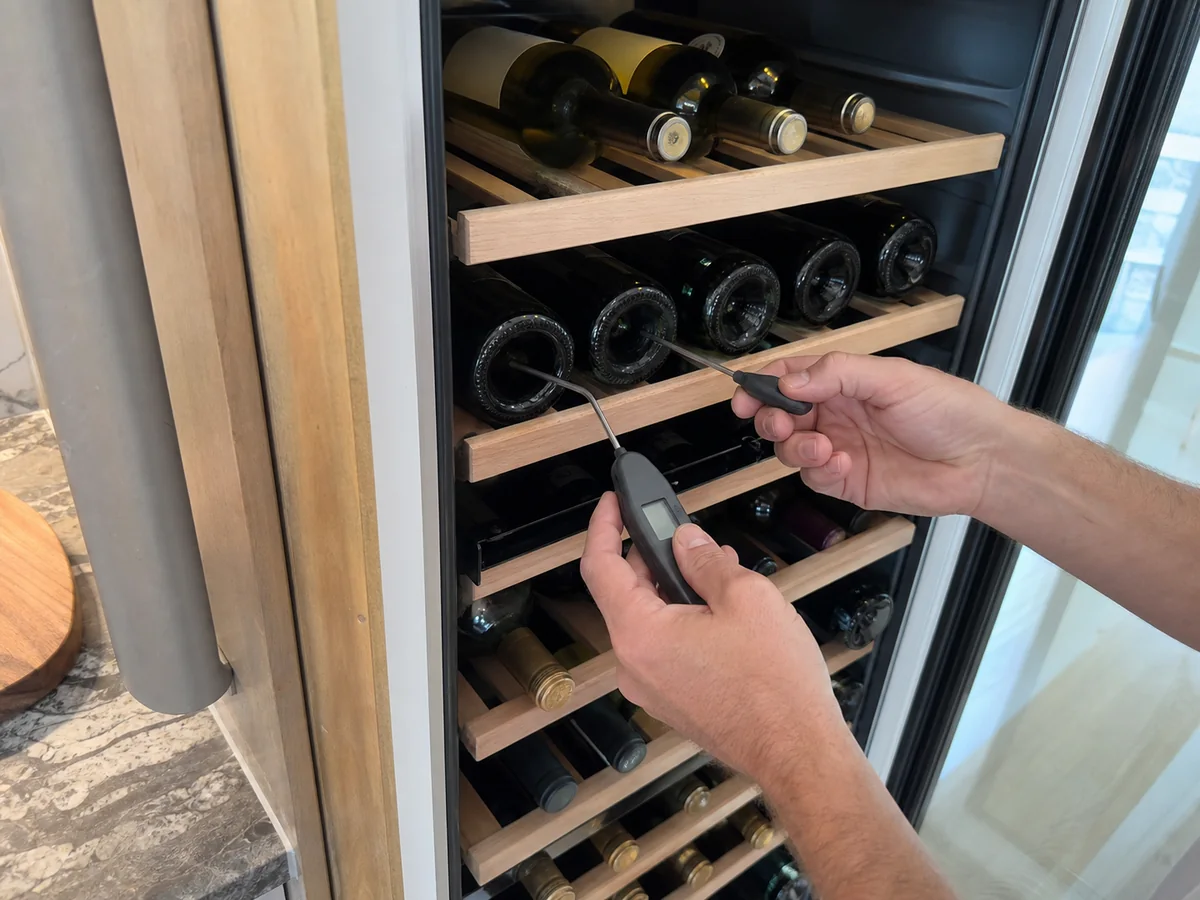
A built-in Sub-Zero wine unit is the quietest appliance in the house until it isn't. Most Foster City owners don't notice trouble from a noise — they notice a number, a row of cabernet that suddenly reads four degrees warm on the upper shelf while the lower zone is still spot-on. That split is the tell, and it is the most common wine-storage call we take across Edgewater Isle, Harbor Side and the Marina Point fingers.
Sub-Zero builds its wine storage to hold a tight band, typically a cool red zone around the mid-50s and a colder white or sparkling zone below it. When one zone drifts and the other holds, the cause is almost never the whole machine. It is one part, and it is usually one of a short list.
Why one zone drifts while the other holds
Dual-zone Sub-Zero wine units split a single sealed system between two compartments using a damper and a dedicated thermistor for each zone. When the upper zone alone creeps warm, the first suspect is that zone's sensor reporting a false-low reading, so the control stops calling for cooling before the wine is actually cool. The second is the damper or its small fan failing to push enough chilled air across the divide. We read both thermistors against a calibrated probe and watch the damper cycle before we touch a part — a drifting zone is a measurement problem first, a hardware problem second.
The Foster City factors: salt air, glass and stillness
Three things about this city shape these repairs. The condenser on a wine unit loads with the same brackish lagoon salt and Bay fog that ages a built-in refrigerator here, and a choked coil shows up as a slow warm drift long before it trips anything. The UV-treated glass door carries a perimeter gasket that, in a humid waterside kitchen, is the part most likely to sweat and break its seal — worth checking before anyone blames the compressor. And because wine units are prized for running still, a worn evaporator-fan bearing or a compressor mount transmitting a faint buzz matters here: that vibration unsettles sediment in older bottles, so a noise complaint is a real fault, not a cosmetic one.
Repair, or replace the column?
Sensors, dampers, fans, gaskets, control boards and a salt-loaded condenser are bounded, well-stocked repairs on a wine unit that is otherwise sound, and a Sub-Zero column is built to run for many years — fixing one of these is nearly always the right call, with the $89 diagnostic credited toward the work. The one place the math changes is a true sealed-system fault, a refrigerant leak or a failing compressor on an older, heavily salt-exposed unit. There we put gauges on it, show you the pressures, and tell you honestly which way the numbers point. Call or book online and we will read it before we recommend anything.