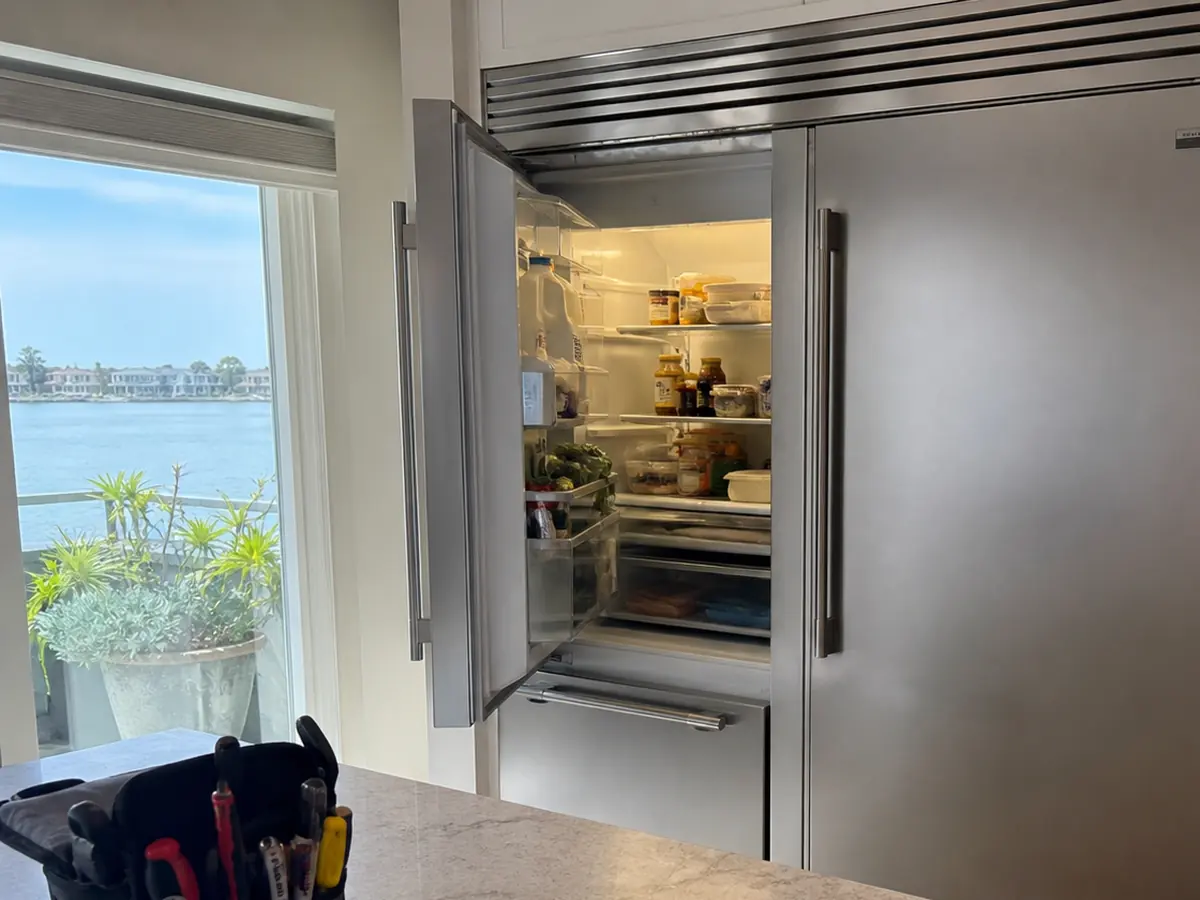
Finding water on the kitchen floor under a Sub-Zero is alarming, and in Foster City it is also expensive if you wait. Almost every home in 94404 sits on a slab poured over engineered bay fill, and the kitchens are finished in engineered hardwood or plank laminate laid directly on that slab. Those floors wick a slow leak sideways under the planks and the toe-kick where you cannot see it, so by the time a puddle reaches open floor the subfloor has often been damp for days. The first job on a leak call is not diagnosis — it is getting a towel and a tray under the unit and stopping the spread.
Once the floor is protected, the leak almost always sorts into one of a few clear sources, and they do not share a repair. The single most common one we find is a frozen or clogged defrost drain. Every cycle the evaporator melts a little frost that is supposed to run down a drain tube to a pan near the compressor and evaporate. When that tube ices over or sludges shut, the meltwater has nowhere to go, so it backs up, overflows the trough, and runs out the bottom of the cabinet onto your floor. People assume a leak means a burst water line, but on a built-in refrigerator the defrost drain is the usual culprit.
The local climate nudges this along. The marine layer that rolls off the lagoon keeps interior humidity high on foggy mornings, which means more condensate for the drain to handle and more door-sweat on the gaskets — so a drain that is only half-clogged tips over the edge here sooner than it would in a dry inland kitchen. Sorting the defrost-drain leak from a supply-line leak and from plain condensation is the whole game, because each one sends us to a different part of the machine.