I wasn't sure whether to repair or replace a 20-year-old built-in. They laid out parts availability, cabinet disruption and cost honestly — repair made sense and it's running great.
Richard P.Sea Colony, Foster City
Decision guide
A Foster City Sub-Zero call that mentions fresh-food section warm while freezer still holds needs more than a keyword match. Around Sea Colony, the installation may be a built-in refrigerator, freezer column, wine unit, or panel-ready cabinet fit that changes how the technician reaches the grille, door seal, controls, and model tag. The first visit should connect the symptom to temperature readings, airflow, cabinet access, and serial-specific part options before anyone recommends a large repair.
Should a built-in Sub-Zero in Foster City be repaired or retired? in Foster City should be handled as a diagnostic-first visit: confirm the model and serial, record temperatures, inspect airflow and visible moisture evidence, then quote the part or labor path only after the symptom is tied to a test.
Last updated: 2026-06-05. Ranges and service notes are reviewed as planning guidance; the written estimate controls final pricing, timing and warranty terms.
I wasn't sure whether to repair or replace a 20-year-old built-in. They laid out parts availability, cabinet disruption and cost honestly — repair made sense and it's running great.
Richard P.Sea Colony, Foster City
Straight advice instead of a sales pitch. They walked through the repair-versus-replace math with real numbers.
Susan M.The Islands, Foster City
Helped me make a confident decision on an older Sub-Zero. No pressure, just a clear breakdown of the trade-offs.
Eric N.Harbor Side, Foster City
ice maker slow, jammed, or producing hollow cubes can sound simple in a phone call, but the confirmation is physical: model and serial number, visible frost or condensation, fan behavior, temperature trend, control response, and whether the condenser area is breathing. What cannot be known before inspection is whether the symptom is a part failure, an installation stress, or a false positive caused by humidity and tight cabinetry.
The local detail matters. Homes tied to Treasure Isle can have moisture, routing, home age, panel thickness, or kitchen access patterns that affect how Sub-Zero service is staged. A waterfront kitchen with stone floors and matched panels should not be treated like a freestanding garage refrigerator.
For wine column drifting several degrees, useful proof includes temperature readings, condenser and evaporator photos, model-tag proof, and serial-matched OEM fan, gasket, or control-board evidence. The recommendation should say what was tested, what remains uncertain, and whether the next step is owner-safe maintenance, a part quote, or a technician-only repair. The Islands is referenced here only where it affects route timing, moisture exposure, or home style.

| Factor | Repair leans stronger when | New-unit plan leans stronger when | Typical cost signal |
|---|---|---|---|
| Age and family | Older built-ins can still be good repair candidates if cabinet fit and part supply are reasonable. | A new-unit plan may make sense if major parts are unavailable and the cabinet already needs remodeling. | Repair $480-$1,380 vs a new built-in $8,000-$14,000+ installed. |
| Cabinet disruption | Panel-ready kitchens make repair valuable when the opening is custom. | A new appliance can trigger panel, floor, trim, and scheduling costs. | Replacement adds $2,000-$6,000 in panel and floor rework. |
| Part availability | Serial-matched fans, gaskets, valves, and boards often keep a unit viable. | Discontinued control or sealed-system parts can change the math. | Serial-matched parts $280-$1,380; discontinued leans replace. |
| Safety and food risk | A fast confirmed repair may protect food and wine inventory. | Repeated warming with uncertain cause may require a larger plan. | Fast confirmed repair starts at the $165-$245 diagnosis. |
| Repair cost | A written estimate tied to tests is useful. | A vague expensive quote is not enough; ask what proof supports it. | Replace when a confirmed repair tops ~40-50% of new-unit cost. |
The owner photo narrows the visit, but the technician test is what should appear on the written estimate.
| Owner can photograph | Useful owner evidence | Technician must test |
|---|---|---|
| Model and serial label | Clear photo of the tag plus a wide shot showing location | Match parts, model family and service instructions. |
| Temperature display and food-zone reading | Photo of display plus owner thermometer reading after door has been closed | Compare actual temperature to control and sensor behavior. |
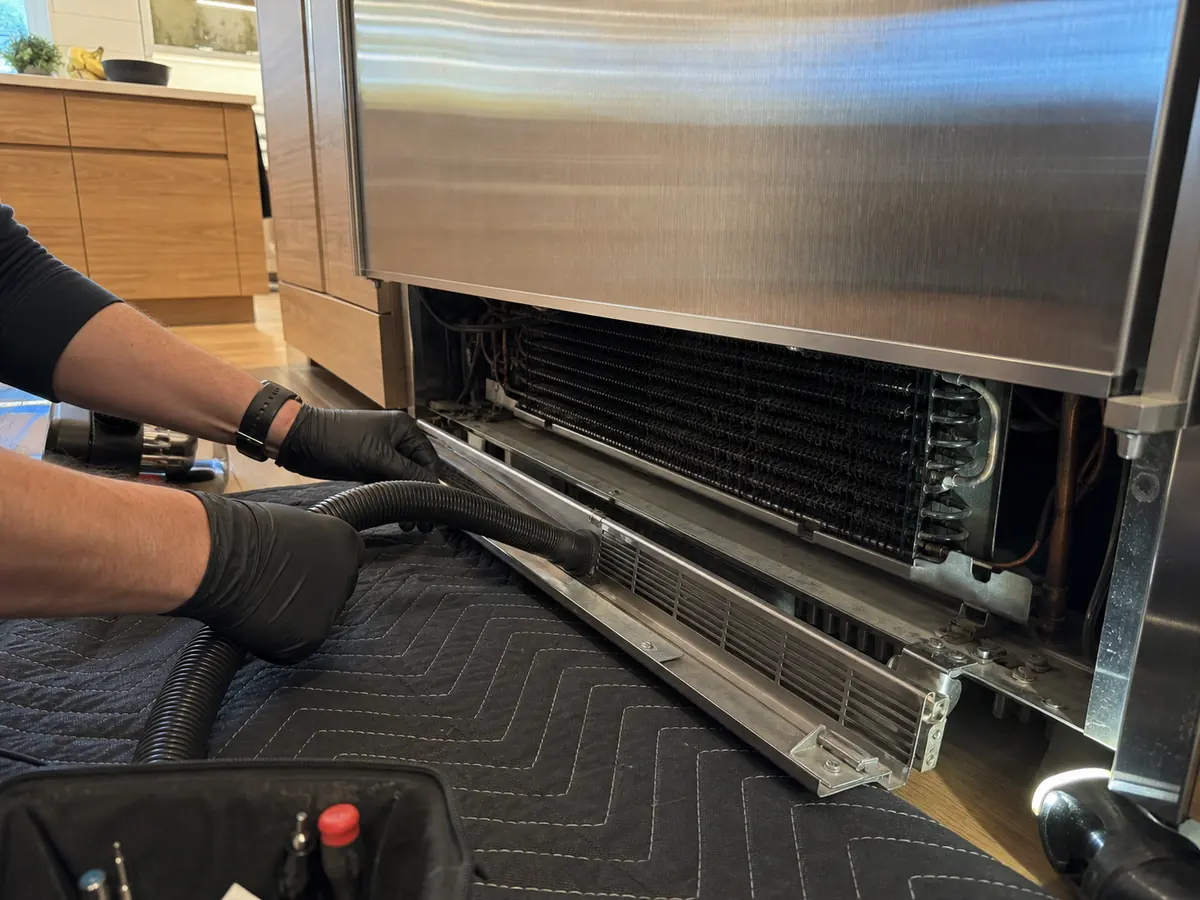
| Lower grille or condenser area | Straight-on photo showing dust, pet hair, corrosion or blocked airflow | Inspect fan behavior, electrical safety and cleaning limits. |
| Ice bin, fill tube or water-line area | Photo of hollow cubes, fill-tube frost, leaks or corrosion | Test fill timing, valve behavior, filter restriction and freezer temperature. |
| Panel gaps and floor path | Wide photo showing custom panels, toe-kick, flooring and route | Plan cabinet-safe access, water-line slack and floor protection. |
These notes are service constraints, not decorative location text.
| Area | Diagnostic relevance | Booking note |
|---|---|---|
| Sea Colony / Treasure Isle / The Islands | Lagoon-side moisture can make gasket frost, slow ice and cabinet humidity overlap. | Have frost-line, ice-bin and model-tag notes ready before the visit. |
| Harbor Side / Edgewater Isle | HOA access, parking windows and water shutoff coordination can affect timing. | Note elevator, parking and water shutoff limits while booking online. |
| Sea Cloud | Slab-home routing and cabinet-safe pull-out planning can change labor time. | Photograph the floor path, toe-kick and lower access area. |
| San Mateo-Hayward Bridge route | Same-day timing is realistic only when model/photo evidence prevents a second trip. | Keep temperatures and symptom photos ready before asking for a dispatch window. |
A few common patterns we see around the lagoon: wide appliance context, close-up part proof, and verification after the repair.
Humid kitchen, freezer mostly holding, condenser access limited by a toe-kick grille; airflow restored and the outcome confirmed by temperature trend.
Condensation line, hinge closure and older millwork pressure resolved with a serial-matched gasket and an alignment check.
Hollow cubes traced through fill timing, freezer temperature, inlet valve and filter history before any assembly was replaced.
Our Foster City Sub-Zero pricing is shown as conditional ranges tied to the diagnosis, not a teaser fee. The range covers the diagnostic visit, the likely part category, the expensive exception, and what would change after model, access and water-path testing.
Diagnostic/service call planning range for model, temperatures, airflow and visible evidence.
Door gasket or frost-line work after model verification and hinge/cabinet checks.
Ice maker or water-line work after separating valve, filter, fill tube and freezer-temperature causes.
Compressor or sealed-system planning range after pressure and electrical evidence.
Call now for quick help, or use the online booking page when you prefer to choose a service window yourself.
Lean repair when the cabinet is custom, the model still has parts, and tests confirm the fault, typically $480-$1,380, versus $8,000-$14,000+ to replace a panel-ready unit installed. Lean replacement when sealed-system or control parts are discontinued, or the kitchen is due for rework anyway.
Significantly. A replacement in a panel-ready waterfront kitchen can add $2,000-$6,000 in cabinet, panel and floor rework on top of the appliance, which often tips the balance toward repairing a unit that still has parts. A standard stainless freestanding swap doesn't carry that hidden cost.
A useful rule: consider replacement when a confirmed repair exceeds about 40-50% of the installed cost of a comparable new built-in ($8,000-$14,000+ here). Below that, repair usually wins, especially with custom cabinetry. The number must come from a tested estimate, not a guess, before you decide.
Most serial-matched gaskets, fans, thermistors, valves and ice-maker modules are still available for older Classic and Designer units, $280-$1,380 installed. The exceptions are some discontinued control boards and a few sealed-system parts. Confirming the model and serial tells us availability before recommending repair or replacement.
Often yes. Panel-ready and integrated installs are built into the cabinetry, so a new unit may need custom panels refit, toe-kick and trim adjustments, and floor protection or repair, $2,000-$6,000 beyond the appliance. This is why a $1,650-$3,950 sealed-system repair can still be the cheaper path.
It should name the tested fault, the model and serial, part availability, the cabinet-disruption risk, expected time, and warranty terms, not just a price. For sealed-system claims, pressure and electrical evidence. A vague high quote without that proof isn't enough to justify retiring a built-in that may still have parts.